Column · @stemdiary84
Choosing Offerings for Saraswati Puja: Key Points
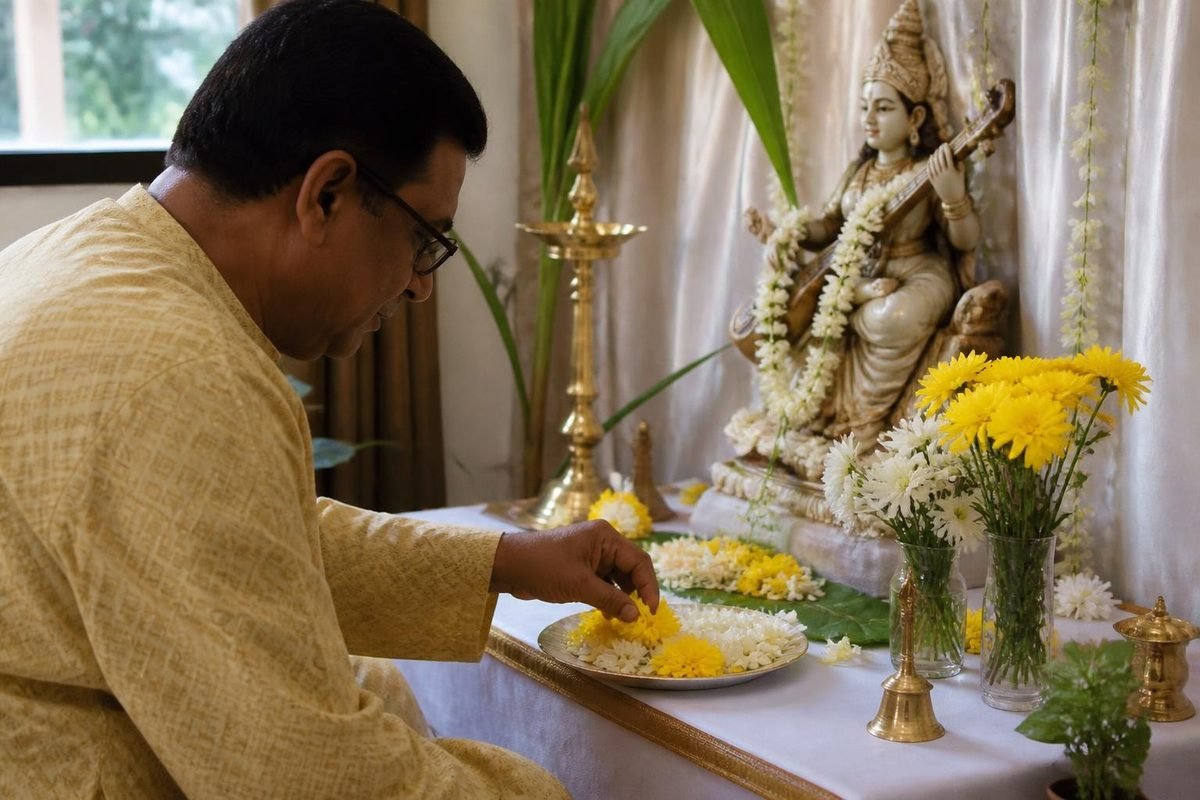
Marigolds, white lotus, jasmine and white chrysanthemums are among the flowers offered during Saraswati Puja. Customs differ between families and regions, so check with a local priest or household elder if you are unsure what is customary at a particular puja.
Flowers you may see at the puja
Marigolds are a common sight at Saraswati Puja. Their yellow and orange flowers may be offered loose, tied into garlands or used to decorate the worship area. Yellow is also linked with Vasant Panchami, the spring festival during which many communities celebrate Saraswati Puja. A few blossoms on a plate and a garland near the place of worship are both familiar ways to use them.
The white lotus has a particular association with Saraswati, who is often shown seated on a lotus. If one is available, it may be placed near her image or presented as an offering. It is not required for every household puja, so there is no need to treat it as the only suitable choice.
Jasmine is used in places where it grows locally. Its small white flowers can be offered individually or gathered into a garland. White chrysanthemums are another possible offering, especially when they are in season and easy to obtain. The flowers seen at a family puja may therefore reflect what is growing nearby or sold locally.
Other local flowers may be part of a household’s practice. An offering that is familiar in one region may not be used in another. If you are visiting someone’s puja, ask the host before bringing flowers. This is particularly helpful if you intend to place them on the altar yourself, rather than simply bringing them for the household to arrange.
Selecting and getting flowers ready
Choose flowers that look fresh, clean and free of clear signs of wilting. If you pick them up before the puja, keep the stems in clean water and leave the flowers in a cool spot until they are needed. These simple steps help them stay in good condition while you prepare other items.
A small offering can be easier to handle than a large bouquet. A few loose blooms on a clean plate may be simple to arrange, while garlands can decorate an image or the space around it. Individual flowers can also be set with the other puja items. The form you choose can depend on what the household uses and what is available.
Some families have particular instructions about suitable flowers and how to handle them. Follow those customs if you know them. If you are not sure, ask before plucking petals, making or adjusting a garland, or setting flowers directly on an image. A quick question before the puja begins can prevent an awkward moment at the altar.
Availability is worth considering as well. Lotus and jasmine may be hard to find in some places. A fresh flower from the area may be a practical option if the household accepts it. There is no single arrangement that every Saraswati Puja must follow.
Common questions about offerings
Do the flowers have to be white?
No. White flowers are associated with Saraswati, but yellow and orange marigolds are also widely used. Practices differ from place to place and among families.
Are marigolds suitable to offer?
Yes. Marigolds are commonly offered and also used to decorate during Saraswati Puja.
Must I bring a lotus?
No. Although the lotus is closely associated with Saraswati, many people offer other flowers that are available locally.
How many flowers should I take?
There is no fixed number that applies to every puja. Ask the host how many to bring if the flowers are intended for a shared offering or for decoration.
A good companion read: safe online gift shopping